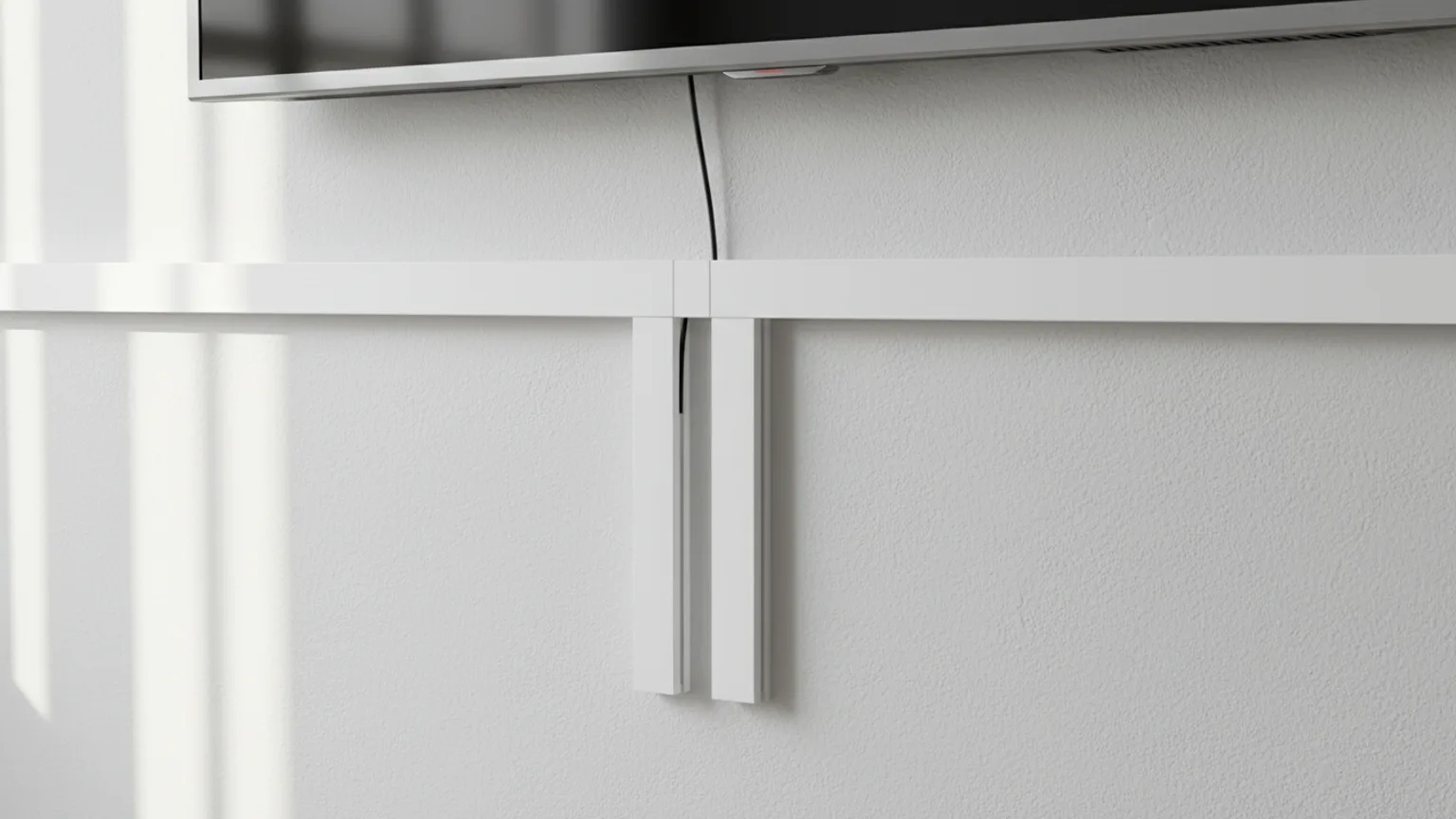
The most practical way to hide TV cables without cutting the wall is to use flat cable raceway trunking — paintable plastic channels that run vertically down the wall from the TV to the sockets below. They are barely visible at normal viewing distances, work on any wall type, and can be removed without damage. This guide covers five methods, from the simplest to the most professional-looking.
Method 1: Cable raceway trunking (recommended)
Cable raceway is a flat plastic channel that attaches to the wall surface and conceals all your cables in a single neat run. Modern profiles are low-profile (as flat as 10mm), paintable, and available in white. This is the method we typically use when in-wall routing is not possible.
What to buy: Look for trunking labelled D-Line, Metra, or similar. A 40×16mm channel is the standard for most TV setups (power, HDMI, aerial). A 2-metre length costs around £8–£15. Buy adhesive-backed for rentals; screw-fixed for a permanent fitting.
Key tip: Always run the trunking vertically, not diagonally. A vertical run from the TV down to the socket looks intentional and tidy. A diagonal run draws the eye and looks improvised.
Method 2: Flat adhesive cable clips
For one or two thin cables (like a single HDMI), flat cable clips or cord holders guide the cable along the skirting board or wall edge without a full trunking run. They are the easiest method to install and nearly invisible at skirting board level.
The limitation is capacity — clips work for 1–2 cables only, and the cable is still visible (just tidily managed). For a full TV setup with power, HDMI, aerial, and Ethernet, trunking is always cleaner.
Method 3: Cord cover strips
Cord cover strips are self-adhesive fabric or rubber tubes that bundle multiple cables together into a single tube. They are popular and affordable (around £10–£20 for 2 metres), but they look best when the bundle runs horizontally along the floor or skirting board — less so on walls. For wall-mounted TVs, vertical trunking is generally cleaner.
Method 4: Furniture concealment
If your TV is above a media unit, console table, or bookcase, you can route cables behind or through the furniture rather than along the wall at all. Mount the TV directly above the unit, keep the cable run as short as possible, and position the unit flush against the wall to hide the vertical drop.
This is the zero-cost option and works well when your media unit goes all the way to below the TV. It does not work well if there is a gap between the unit and the TV.
Method 5: Behind-wall routing (the cleanest result)
Hiding cables inside the wall — through the plasterboard or behind plaster — gives a completely clean result with zero visible cabling. This is the premium finish: when done well, the TV appears to float on the wall with nothing visible beneath it.
This requires cutting small apertures in the wall, routing cables through the cavity, and patching and redecorating. For a solid brick wall it is more involved (chasing a channel into the plaster). This is not suitable for renters, and power cables must be handled correctly under BS 7671 wiring regulations (using appropriate conduit, not run loose inside a cavity).
We offer professional cable hiding as a standalone service — priced separately from the TV mounting itself. We handle the patching and redecorating on standard plasterboard walls. For brick walls or solid concrete, we advise on the best approach before proceeding.
Which method should you choose?
| Method | Suitable for renters? | Cables fully hidden? | Cost (DIY) | Difficulty |
|---|---|---|---|---|
| Cable raceway trunking | Yes (adhesive) | Mostly | £10–£20 | Easy |
| Adhesive cable clips | Yes | Partially | £5–£10 | Very easy |
| Cord cover strips | Yes | Partially | £10–£20 | Easy |
| Furniture concealment | Yes | Mostly | £0 | None |
| Behind-wall routing | No | Completely | £30–£80 materials | Advanced |
Renting? What you can and cannot do
If you are in a rented flat, trunking with adhesive backing is fully renter-safe — peel it off when you leave. Screw-fixed trunking leaves small holes (no different to picture hooks) but check your tenancy agreement if in doubt. In-wall routing is generally not permitted in rented properties without written landlord consent.
We have a full guide to TV mounting in rented flats covering what is and is not allowed, and our make-good service for restoring walls when you move out.
Step-by-step: installing cable trunking
- Measure the cable run — from the TV mounting point down to the nearest socket. Add 10% for turns.
- Choose the right raceway profile — 40×16mm for 3–5 cables; 60×22mm for 6–8 cables.
- Mark the route with a spirit level — always run vertically or horizontally, never diagonally.
- Attach the raceway base — peel-and-stick for rentals, screw-fixed for permanent. Press firmly for 30 seconds along the full length.
- Route all cables into the channel — no cable should be pinched at corners or entry points.
- Click the cover on — run your finger along the full length to confirm no gaps.
- Paint to match (optional) — once set (24 hours), standard matt emulsion gives a near-invisible finish.
FAQ
What is the cleanest way to hide TV cables without cutting the wall?+
Flat cable raceways (also called surface cable channels) give the cleanest result without any wall work. They are painted to match the wall, sit flush against the surface, and are barely visible from normal viewing distances. PVC raceway with a 40mm × 16mm profile fits most HDMI, power, and aerial cables in a single run.
Can I hide cables in a rented flat without losing my deposit?+
Yes — cable trunking and raceways attach with adhesive pads rather than screws, making them fully removable. The only potential issue is paint marks from adhesive removal, which can be cleaned with appropriate solvents. We cover this in detail in our rented flat mounting guide.
How many cables can fit in a standard cable raceway?+
A standard 40mm × 16mm cable raceway (the most common size) fits 3–5 cables comfortably — typically power, HDMI, aerial, and an Ethernet cable. Larger 60mm × 22mm profiles fit 6–8 cables. We always use the right size for the number of cables in your setup.
Is hiding cables inside the wall better than using trunking?+
In-wall cable hiding gives the cleanest possible result — zero visible cables at all — but requires cutting the wall, which is not always possible or desired. Trunking gets you most of the way to that finish and is reversible. For renters or listed properties, trunking is often the only viable option. For owners who want perfection, in-wall is worth it.
Can you hide a power cable in a wall?+
Power cables (mains 230V) must not be run inside wall cavities in standard trunking — this is a UK wiring regulation (IET Wiring Regulations BS 7671). Power cables must either use specialist in-wall conduit installed by a qualified electrician, or run in surface-mounted cable management trunking that is rated for mains voltage. We do not run power inside a wall cavity without proper conduit.
When we mount a TV, cable management is included as part of the job. We assess your wall type, cable count, and whether behind-wall routing is feasible before recommending the best approach for your property. See our TV installation and mounting service for full details, or get a free estimate in 60 seconds.