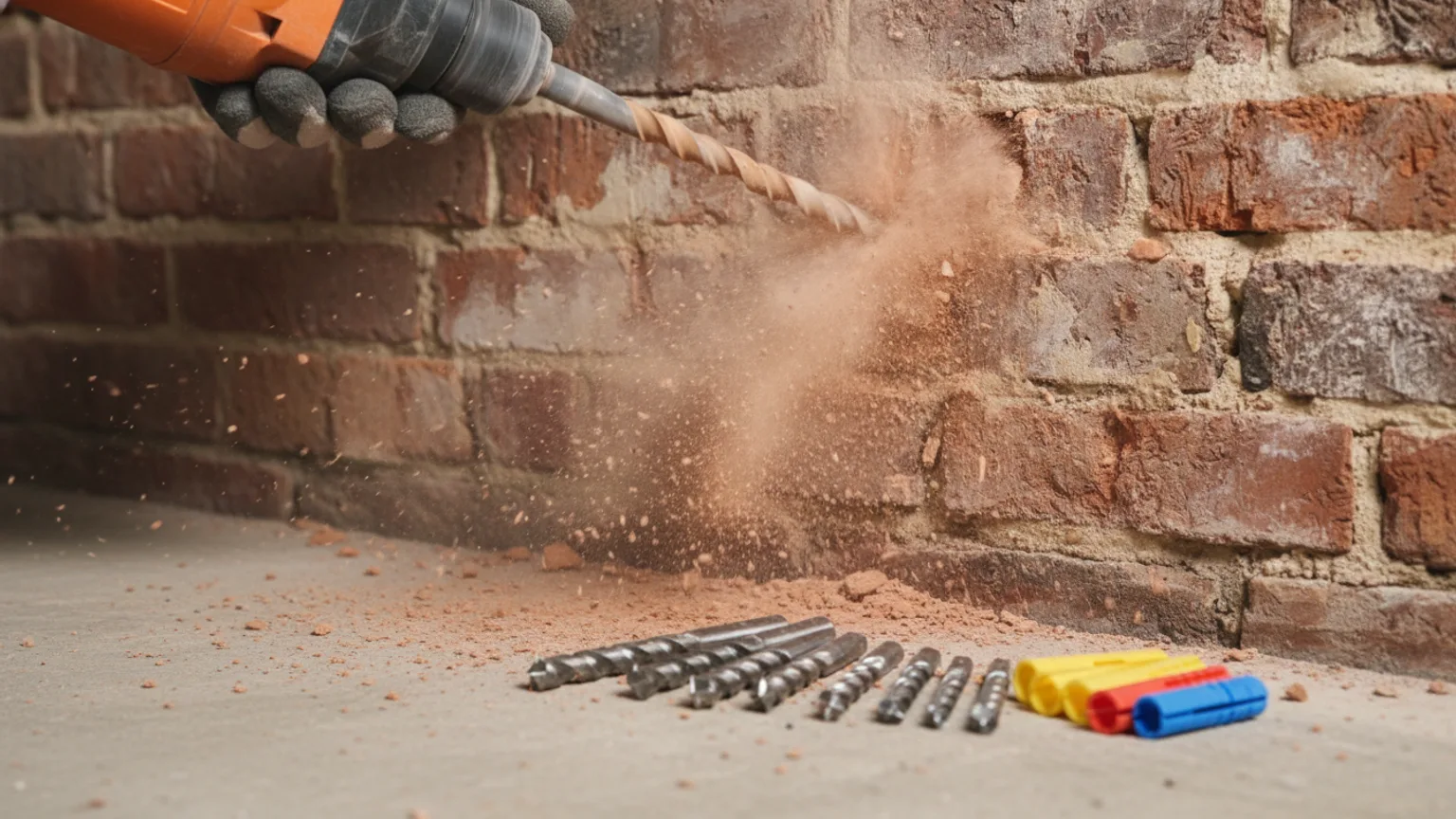
Solid brick is one of the most reliable wall types for TV mounting in UK homes. Unlike plasterboard, brick does not rely on finding timber behind it — the masonry itself provides the fixing point, and with the correct anchors, load capacity is well above anything a domestic TV installation requires. The key is using the right drill, the right anchor, and — for Victorian properties — the right technique for lime mortar.
First, check it really is exposed brick. A lot of London "brick" walls — particularly in new builds and 1980s-onwards refurbs — are actually plasterboard bonded to brick with adhesive dabs, leaving a hollow gap behind the board. It knocks hollow but feels solid because the brick is right behind. The fixings on this page assume you are drilling directly into the brick. If the wall sounds hollow when knocked, read our dot-and-dab TV mounting guide instead — standard masonry plugs will sit too shallow and pull through. Identifying the wall correctly before the first hole is one of the calls City & Guilds Level 3 training is for.
Types of brick wall in UK homes
Not all brick walls are the same, and the difference matters when choosing your method:
- Modern solid brick (post-1945) — Dense, hard brick laid in Portland cement mortar. The most straightforward to drill. Use SDS hammer drill with masonry bit, 8–10mm diameter, and heavy-duty wall plugs or Rawlbolts.
- Victorian and Edwardian brick (pre-1920) — Softer, hand-made brick laid in lime mortar. Requires rotary-only drilling technique to avoid crumbling mortar joints or shattering brick faces. More common in London terraces than anywhere else in the UK.
- Cavity brick wall — Two leaves of brick with a 50–100mm air gap between them. Internal fixings only reach into the outer leaf. Use shorter anchors (50mm) and avoid applying torque that could crack the inner brick face.
- Chimney breast — Solid brickwork all the way through, often the most reliable fixing surface in the room. See our chimney breast mounting guide.
The right drill for a brick wall
For any modern brick wall, an SDS rotary hammer drill is the correct tool. A standard corded or cordless drill will struggle with hard engineering brick and will overheat or damage the bit before you reach the required depth. SDS drills have a dedicated hammer mechanism that is separate from the rotary action — efficient, clean, and fast through hard masonry.
For Victorian lime mortar brick, use the SDS in rotary-only mode (most SDS drills have a mode switch: rotary only, hammer only, or rotary + hammer). The hammer action in full SDS mode applies vibration shock that can blow out lime mortar joints and crack softer brick faces. Rotary-only is slower but gives a clean, round hole in the softer material.
Choosing the right fixings
The fixing type depends on the TV weight and bracket type:
- Standard nylon wall plug (plastic plug + screw) — Suitable for TVs up to approximately 30kg on a flat or tilt bracket. Use 8mm plugs in 8mm pilot holes for most domestic installations. Not recommended for full-motion brackets, which apply lateral forces that the plug threads cannot resist.
- M6 Rawlbolt anchor — A metal expansion anchor bolt. Significantly higher pull-out and shear resistance than nylon plugs. Use for TVs over 30kg or any full-motion bracket regardless of TV size. Requires a 10mm pilot hole.
- M8 Rawlbolt anchor — For 75-inch and above or where the bracket manufacturer specifies M8 fixings. Requires 12mm pilot hole. Overkill for most domestic TVs — but there is no downside to using a larger fixing than strictly necessary.
How many fixing points do you need?
Most TV wall brackets have four fixing holes — two per column, set 100–400mm apart depending on bracket design. All four should be used wherever possible. Reducing to two fixings doubles the load per anchor and increases the risk of bracket movement over time. Our professional installations use all available bracket fixing points.
Scanning for pipes and cables first
Brick walls in UK homes can contain: electricity cables chased into the mortar joints, water pipes in external walls (particularly in kitchens and bathrooms), and gas pipes in older properties. Always scan with a combined pipe and cable detector before drilling. Pipe detectors that rely only on metal detection will miss plastic pipes — use a model that also uses radar or radar-assisted detection.
We use professional-grade scanning equipment on every installation. The scan takes about three minutes and is part of our standard process regardless of how straightforward a wall looks.
When to call a professional
DIY brick wall TV mounting is achievable for a confident person with the right tools. However, consider calling a professional when:
- The wall is Victorian lime mortar and you are not confident with rotary-only technique
- The TV is 65-inch or larger (two-person lift required, VESA verification needed)
- You are using a full-motion bracket (higher fixing loads, more critical alignment)
- The wall may contain hidden pipes or cables and you do not have a scanner
- The wall is a chimney breast and you need to check for active flues
Our professional brick wall TV mounting service includes all equipment, fixings, and scanning — see our current pricing.