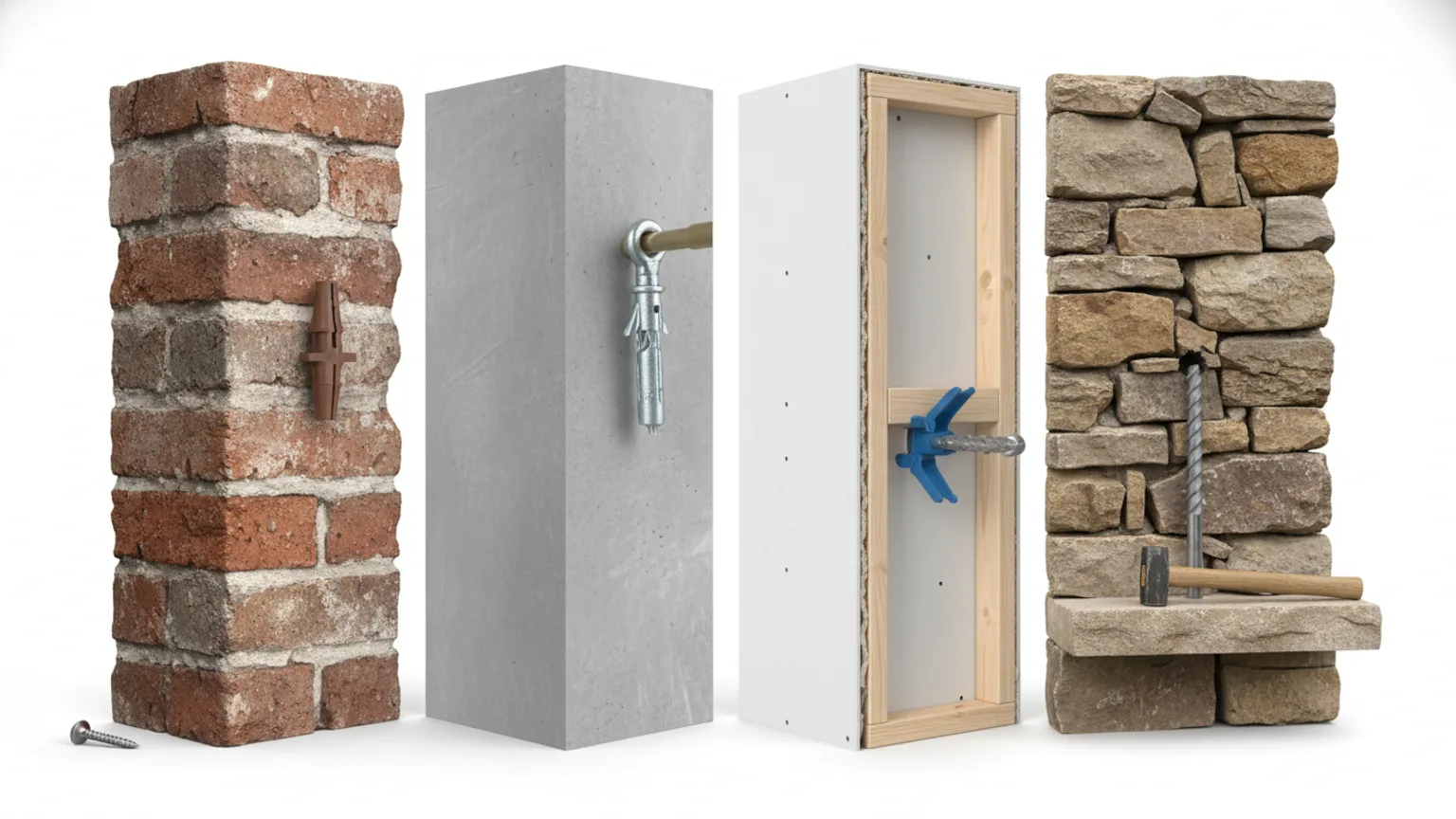
A TV can be mounted on essentially any wall type found in UK homes — solid brick, plasterboard, concrete, stud walls, stone — provided the correct fixings are used. The wall type determines which fixings are appropriate. Here is a complete guide to every wall type you are likely to encounter and what it means for your installation. For a full breakdown of what the job involves and what it costs, see our TV installation and mounting service page.
Wall types at a glance
| Wall type | Common in | How to identify | Fixing used | Difficulty |
|---|---|---|---|---|
| Solid brick | Pre-1960 homes, chimney breasts | Solid knock, dense feel | Masonry plugs + screws | Easy |
| Hollow plasterboard | Modern new builds, internal walls | Hollow knock | Cavity anchors (Grip-It, Toggler) | Moderate |
| Plasterboard on stud | Most UK homes post-1960 | Hollow knock, studs detectable | Stud fixing or cavity anchors | Easy–moderate |
| Dot-and-dab on brick | 1980s–today new builds and refurbs | Hollow knock but feels solid behind | Long anchors through the gap into the brick | Moderate |
| Concrete / block | Flats, 1960s–80s buildings | Very solid, slow to drill | Heavy-duty masonry anchors | Moderate |
| Lath and plaster | Victorian / Edwardian homes | Hollow sound, plaster surface | Screws into lath or cavity fixings | Moderate |
| Stone / flint | Period country / coastal properties | Irregular surface, natural stone visible | Heavy-duty masonry anchors | Moderate–hard |
| Timber stud only | Older partition walls | Hollow, stud found on probe | Direct screw into stud | Easy |
Solid brick
Solid brick is the easiest and most reliable surface for TV mounting. Victorian and Edwardian properties (built before 1920) typically have solid brick internal walls. Chimney breasts are solid brick in virtually all UK homes. Masonry plugs are inserted into drilled holes and the bracket screws in tightly. The holding strength is very high — far above anything a domestic TV requires.
External walls in pre-1960 properties are also solid brick, but be aware of cavity walls (two leaves of brick with a gap between) in properties built from the 1920s–40s onward — the outer leaf is brick, but the inner leaf and internal walls may be block or brick of a different type.
Plasterboard (hollow)
Plasterboard is the standard internal wall finish in all new-build properties and most converted flats built or refurbished after 1970. It is 12.5–15mm thick with a hollow cavity behind it. Standard wall plugs cannot be used — they pull straight through. Cavity anchors (Grip-It, metal toggle bolts, Toggler snaptoggle) expand behind the plasterboard face to grip from behind. With the right fixings, plasterboard is reliably safe for any domestic TV. See our TV mounting on plasterboard guide and our large TV on plasterboard guide for more detail.
Plasterboard on timber or metal stud
The most common internal wall type in modern UK homes. Plasterboard is fixed to a frame of timber or metal studs, typically spaced 400mm or 600mm apart. If your bracket mounting holes align with the studs, screwing directly into the stud gives the strongest possible fixing. Where holes fall between studs, use cavity anchors. We locate studs with a stud finder on plasterboard jobs.
Dot-and-dab on brick
Dot-and-dab is the standard way plasterboard is fixed to brick or block walls in UK new builds and refurbishments from the 1980s onward. Adhesive "dabs" bond the plasterboard to the brick behind, leaving a hollow gap (typically 10–25mm) between the board and the masonry. The wall sounds hollow when knocked but feels solid because the brick is right behind it — which is why it catches DIY installers out: standard cavity anchors expand into empty air, and standard masonry plugs sit too shallow in the brick. The correct approach is a long anchor that bridges the gap and grips deep into the brick. A regular wall type for us across London new builds — we identify it on the day before drilling and select the anchor length to match the cavity. For a full walkthrough see our dot-and-dab TV mounting guide.
Concrete and block
Reinforced concrete and dense concrete block are common in purpose-built flats from the 1960s to 1980s. These walls are very strong but harder to drill than brick — they require SDS hammering action and the correct masonry bit. Standard drill bits blunt quickly on concrete. The fixings used are heavy-duty masonry anchors rated for higher loads. Concrete walls mount TVs very securely once drilled correctly. See our dedicated TV mounting on concrete wall guide.
Lath and plaster
Lath and plaster walls are found in Victorian and Edwardian homes where the original internal walls have not been replastered or replaced. Thin timber laths are fixed horizontally across the stud frame and covered with several coats of plaster. The surface looks and sounds solid but is thinner than brick. Screwing into the lath itself gives a reasonable fixing for light items. For TV mounting, we locate the studs behind the laths and use stud-mounted fixings, or use heavy cavity anchors through the laths into the wall cavity.
Stone and flint
Stone walls are found in period rural and coastal properties — particularly in the Home Counties, Kent, and further afield. They can include sandstone, limestone, flint, or a mix. The challenge is that stone varies enormously in hardness and consistency — some types drill easily, others fracture unexpectedly. We use specialist masonry bits and heavy-duty anchors, and always assess the specific stone type before drilling. Flint in particular requires very careful approach as it is extremely hard but can fracture.
How we identify your wall type before drilling
Before any drilling, we:
- Knock-test the wall and probe with a pilot hole to identify the wall type
- Use a stud finder to locate studs and an electronic detector to check for hidden pipes and cables
- Select the appropriate fixing type and size for the wall construction and TV weight
- Advise you on the approach before starting
If you are not sure what wall type you have, tell us the property type and approximate age when you get a quote — we will advise. See our current pricing for all wall types and TV sizes.