Dot-and-dab is one of the most common interior wall finishes in UK homes built or refurbished since the 1990s. It is also the wall type most often misdiagnosed as “just plasterboard” — and the cause of most TV-came-off-the-wall calls we attend. The fix is straightforward once you understand what is actually behind the plasterboard.
What dot-and-dab actually is
Dot-and-dab (also called “direct bond”) is a finishing method where sheets of plasterboard are stuck to a solid wall — usually brick, block, or concrete — using dabs of plasterboard adhesive. The dabs sit roughly 200–300mm apart in a grid. Once the adhesive cures, the result is a flat plasterboard finish with a 10–25mm air gap between the plasterboard and the masonry behind, broken only by the dabs of dried adhesive.
From the room side, it looks identical to a stud wall. The crucial difference is what fills the cavity: on a stud wall, nothing — empty space between studs. On dot-and-dab, the cavity is mostly air with adhesive dots, and behind that is solid masonry.
How to identify a dot-and-dab wall
- Knock test — Tap the wall in several spots. Dot-and-dab gives a hollow sound between dabs and a more solid sound on top of a dab. A pure stud wall is hollow everywhere with the studs as the only solid points (every 400 or 600mm).
- Property age and type — Most homes built or renovated since the 1990s use dot-and-dab on external solid walls. Older period properties usually have plaster directly on brick (wet plaster) or lath and plaster.
- Pilot drill confirmation — A 6mm pilot hole tells you everything. You will feel: 12mm of plasterboard (gritty resistance), then a sudden drop into air gap (10–25mm of nothing), then the drill bites into solid masonry. That sequence confirms dot-and-dab.
Why standard plasterboard fixings fail on dot-and-dab
Standard cavity anchors — Grip-It, Toggler, Snaptoggle — are engineered for stud-cavity construction with one layer of plasterboard and a deep empty cavity behind. On dot-and-dab, the cavity is shallow (often only 10–15mm) and the plasterboard itself is held to the wall by adhesive dabs spaced 200–300mm apart. The pull-out failure mode is different and more aggressive:
- The cavity anchor flares behind the plasterboard, gripping the back face of the board.
- Heavy TV load creates leverage on that grip point.
- The plasterboard itself peels away from the adhesive dabs — the failure point is the adhesive bond, not the anchor.
- You see a visible gap appear between the plasterboard and the wall, the bracket tilts forward, and eventually the TV pulls clean off.
We attend at least one dot-and-dab failure every month — almost always a TV mounted with cavity anchors. The customer is rarely at fault: the packaging on the anchors says “for plasterboard up to 25kg,” and the wall is plasterboard. The packaging does not call out dot-and-dab as a different case.
The correct method: anchor into the masonry behind
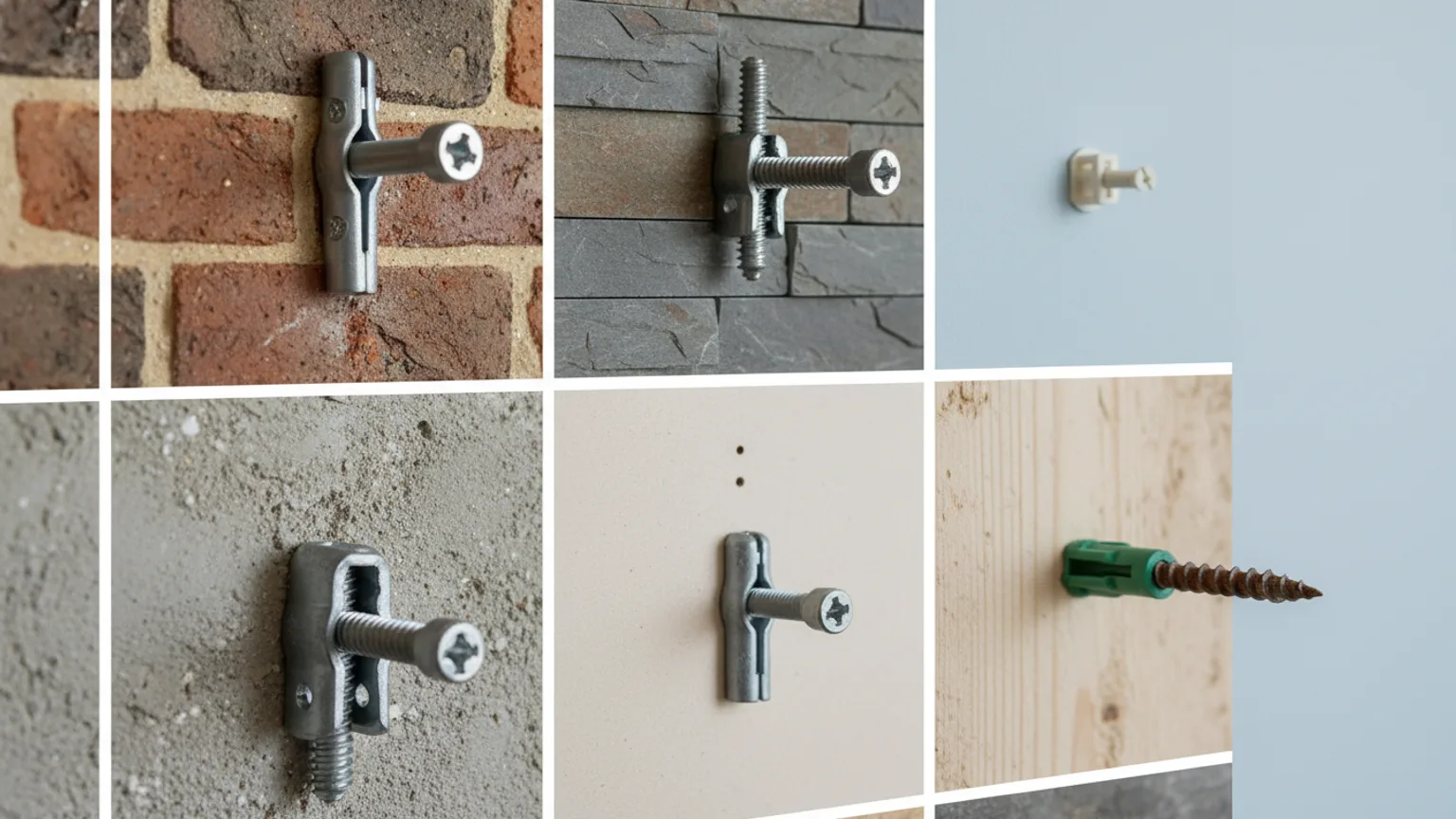
On a dot-and-dab wall, all the load should be carried by the solid wall behind, not the plasterboard. The fixing has to bypass the plasterboard and bite into brick or block. The correct fixings are:
- Sleeve anchors (Rawlbolt, Fischer FUR) — M8 or M10 sleeve anchors of 80–120mm length. The sleeve passes through the plasterboard and air gap, then expands inside the masonry. Engagement into the solid wall must be at least 50–60mm.
- Frame fixings — Hammer-in expansion fixings designed specifically for fixing through plasterboard into masonry behind. Fischer SXR and Rawlplug R-FF1 are the common UK options. Fast to install, very strong on solid backing.
- Resin anchors — For very heavy TVs (45kg+) or where the masonry behind is older or softer (sandstone, weak block), chemical resin anchors give the highest pull-out strength. We use these for commercial 75-inch and 85-inch installations on uncertain backing.
For a typical 32–55-inch domestic TV, M8 frame fixings or M8 sleeve anchors at four points are correct. For 65-inch and above, step up to M10 and add a fifth and sixth point if the bracket allows.
Avoiding cracked plasterboard when tightening
The one risk specific to dot-and-dab is crushing the plasterboard between the bracket and the masonry as you tighten the bolts. The plasterboard sits proud of the wall by 10–25mm, so over-tightening pulls the bracket against the plasterboard hard enough to crack the surface or pull adhesive dabs loose.
The solution is a tubular spacer between the bracket and the plasterboard, sized to the cavity depth. The spacer means the bolt clamps the bracket to the masonry through the cavity — without compressing the plasterboard. Tighten until firm; the plasterboard finish stays flush and undamaged.
When to bring in a professional
Dot-and-dab is a wall type where the difference between a safe install and a failed one is entirely about diagnosis and fixings — not skill with a drill. If you are confident the wall is dot-and-dab, the masonry behind is sound brick or block, and you have the correct sleeve anchors or frame fixings, a competent DIYer can complete the job. If any of those conditions are uncertain — or the TV is over 50-inch — the consequences of getting it wrong (TV on the floor, damaged plasterboard, repair plus reinstall) are usually higher than the cost of professional installation.
Our TV mounting on plasterboard service covers all plasterboard variants including dot-and-dab — we identify the wall type on arrival and fit the correct anchors for the actual construction. To book a free estimate, use the quote form or Call Us.